Thursday, October 19, 2006

How to Hire a Web Analyst - Part 2: Personality

In my previous post, I outlined what I have found to be the right mind set, and the right core skill set to look for in a web analyst, especially when you're looking to hire someone whom you plan to groom into the role.

Today's topic is personality. I've observed three personalities in the quality analysts I've known:

  1. The Critic
  2. The Explorer
  3. The Expert

In reality, pieces of each personality are in everyone I've ever hired or recommended for hire as an analyst, and each is a critical component of a successful individual. I've found that, in a given individual, one personality tends to dominate.

The Critic

The Critic personality is someone who is generally driven to question what is presented as "truth", "fact", or "good". They find reward in uncovering "things that aren't right", creating an understanding of what they've uncovered, and receiving recognition that they've uncovered something valuable. Of course, there is a pitfall to this personality. As with all strengths, this personality taken too far can become a weakness. You don't really want your analysts to go to your marketers and tell them point-blank that their work is awful. Your management challenge with this personality will be to teach them to soften the message to the business; to teach them that it's just as important to show people what's working as it s to show them what isn't working.

The good news is that I've found that this personality is generally well educated, well spoken, and able to distill complex ideas into simple truths, as that is the nature of the Critic. They also tend to be good writers and communicators.

The Explorer

The Explorer personality is curious and driven to understand, but doesn't have the potentially negative "critical" outlook of the Critic personality. They find reward simply from the process of exploring the depths of possibility in the data, and also from "driving good results" for the business. This personality will tend get frustrated if the business doesn't know how to put him or her to good use, but is an extremely valuable contributor when they are used appropriately. As with all personalities, there is a pitfall. The urge to explore has to be put aside at some point in order to finish the analysis, create the story, and drive the actions necessary to create positive impact on the business. Your management challenge with this personality will be to let them explore to the extent required for the business, and to help them develop the discipline required to have an end in sight and work toward that end.

This personality doesn't have the strong correlation to the simplifying mind set that I've found in the Critic. You'll need to watch for that.

The Expert

The Expert personality seeks to be seen as an expert in all that they chose to take on. They receive reward from recognition of their expertise in any number of subjects. This personality makes an excellent consultant, and you'll often find them in a consulting role. This is a confident personality, able to gain trust from their audience even when they don't have all the answers. It's a good personality to have around. Don't confuse this personality with the confident huckster. You still need to watch for the core mind sets (analytical, simplifying) and the core skills of communicating and writing succinctly. You're looking for someone who truly is and seeks to be expert in what they do, not just confident.

I've seen this personality in a wide range of education levels and with varying degrees of communication skill. Look for someone with excellent person to person communication ability, with reasonable writing ability. You may need to coach on the softer business skills such as protocol.

Backgrounds

In the next and final post in this series, How to Hire a Web Analyst, I'll look at some of the work experiences and educational backgrounds that I've seen in top notch analysts. Here's a teaser for you... Statistics isn't on my list.

Tuesday, October 17, 2006

How to Hire a Web Analyst - Part 1: Mindset and Key Skills

Hiring a web analytics expert - a web analyst - can be quite a difficult task, especially if you're just starting the process of building the web analytics function at your company. Experienced analysts are in high demand, and are demanding high salaries as a result. By the same token, hiring inexperienced analysts, or even hiring people with no analytics experience at all, can be a risky bet.

What's the right way to solve this puzzle? Over the next week or so, starting with this post, I'll be posting a series on this very topic - how to build out the analytics function without hiring only highly experienced web analysts.

Recognizing a Good Web Analyst

Who will make a good web analyst is more a question of mindset and personality than it is of rote skills or past experience. Of course, hard skills and past experience make a difference, but you'll quickly find that experienced web analysts are in high demand, and are demanding increasingly higher salaries. As a result, the most efficient way to build your organization is to hire one solid analyst, if you can find one, then focus on building a team of people who, based on mindset, personality, and key non-analyst skills, can be quickly groomed to be solid web analysts. To do this, you have to look at candidates not for "what they've accomplished" but for "what they're capable of."

Mindset and Key Skills

A good analyst has an analytical, problem-solving mindset. They constantly seek to understand why things are the way they are, how seemingly unrelated things are connected, and to be able to explain that all to others. They think systemically, meaning that they have a fundamental belief that all things are connected (i.e. "if I push here, something will fall out over there"). A good analyst also has a simplifying mindset. They look for ways to distill complex ideas into simple, fundamental concepts that are understandable by everyone. This latter ability is crucial - in order to drive action from data, the data has to be turned into a story that is consumable by marketers and business people, and from which actions or "next steps" can be derived. The last thing you want is an analyst that simply overloads your marketers and managers with data.

The only hard skill I've been able to identify that has a connection to the mindset described above is writing. An individual who can clearly explain complex ideas in writing is demonstrating the ability to analyze and simplify. An individual who cannot write succinctly cannot be a good analyst. (They may actually understand what's happing in the data, but if they can't communicate it, what good does that do you?)

Personalities

In my next post, I'll cover the three main personalities I've observed that make quality web analysts: The Critic, The Explorer, and The Expert.

Wednesday, August 23, 2006

Decker (again): Only 3 ways to drive revenue

Sorry if you're sick of Sam Decker. I think he's well worth your attention, though, so listen up. In number 5 of his Marketing Bullseye series at Decker Marketing, Sam reminds us of a fundamental truth for online merchants, be you selling widgets or financial products (we're all retailers, after all). And that truth is this -- there are only three ways to drive revenue:

  1. Get more customers [acquisition]
  2. Get more from each customer [increase size of average order]
  3. Get customers to frequent {I would say purchase} more often [increase lifetime value of individual customers].

Sam goes on to detail steps you should take to execute on these sources of revenue, ending with this: 'Track progress against the goals.'

Ahh, the devil's in the details. How do you track progress against those goals? Online, this is where a robust web analytics package, coupled with a robust, well thought out online measurement strategy comes into play. A well implemented analytics package will make it easy for you to adopt the discipline of setting goals and measuring against them for each of the three sources of revenue.

It's been my experience, though, that banks and financial services companies struggle to see themselves as retailers, even though this is precisely what they need to do to be successful selling products online. If you're in this boat - you're hindering your own success.

So, how do you track progress against goals for each of the three sources of revenue?

First Things First
First of all, you need to have a way to track sales of individual products. This is a stumbling point for a lot of banks and financial services companies, as there is usually no revenue directly associated with an online sale. Even at the most advanced companies, it is rare that a financial product, such as a loan or credit card is approved, closed, and funded online, making the tracking of actual revenue a little less intuitive when implementing web analytics.

Most companies only get the customer as far as submitting an application online, taking the approval and closing process offline. Some may give an approval online, while others stop at simply allowing the customer to download an application so they can mail it or bring it to a branch. The point is, though, it doesn't matter. You can attribute revenue to any of these activities, and this is what you have to do.

In the case of a bank that accepts applications online, do an offline analysis that tells you what a submitted application is worth to the company. Use Sam's workback waterfall, which I 'borrowed' here, to figure out what what % of apps are approved, what % of approved are closed, and what the average value of a close is to the company in either total dollars or first year revenue. Then work backwards to figure out how much each submitted application is worth, and apply that value to each "sale" in your web analytics package. Do this at the product level, not at a global level. A mortgage is worth something wildly different than a credit card, and you don't want to blend those values or you'll end up with data that is a lot less actionable.

Treat the sale process the same way a retailer does: record key business events in the sale process. At the individual product level, record at least product views, application starts, product add-ons (you do cross-sell, don't you?), application submits, and product value ($$). A robust analytics package will allow you to roll individual product data up into multiple levels of product families/categories that map to your particular business.

Second Things Second
So now that you've got a strategy for reporting on product sales, including revenue, you need a strategy for reporting on your marketing efforts. Most of the top-tier analytics companies treat marketing programs in a similar way, allowing you to assign an identification code to each individual marketing piece so you can track the performance of the individual campaign or offer, as well as see rolled-up views of various groups of IDs. For example you can see all creative versions in a particular offer, all offers in a particular campaign, and all campaigns in a particular channel (such as email or banners).

So now you've got the fundamentals in place: marketing tracking, and product sales tracking. You are now armed to measure your execution on Sam's plan for driving revenue from the three sources available to you. So, how do you do that? Glad you asked -- this part is actually really easy.

Get More Customers
The key word here is customers. You don't want traffic, you want customers. How do you know if your marketing campaigns are delivering customers, not just traffic? Remember the 'business events' recorded during the sales process? Topline analytics packages will allow you to correlate those businesses events to your marketing IDs, making it possible for you to see not only which efforts drive the best response, but which efforts drive the most product sales. Analytics packages typically let you break out new buyers from returning buyers, too. New buyers=more new customers.

Get More from Each Customer
This is why it is important to calculate product revenue at the individual product level, not as a global average as we discussed above. Just as you can correlate product sales to individual marketing efforts, so too can you correlate revenue. Want more from each customer? Try increasing the average value of each sale. How do you do this?

Try cross-selling additional items in your product application process. "Want a credit card with that?" "How about signing up for Online Banking while you're at it?" Or try targeting higher value products (HELOCs vs. Credit Cards). Don't just drive new customers, driver new, higher value customers.

If you want more from each customer, you have to sell more. To sell more you have to think, act, and measure like a merchant.

Get Customers to Frequent/Purchase More Often
This is simply a matter of getting existing customers to buy again, see Get More Customers above, but look at repeat buyers instead of new buyers. Additionally, many analytics packages will allow you to see sales cycle data on individual products, or groups of products. If your goal is to increase purchase frequency, you would seek to see an increased number of buyers with a decreased number of days between purchases.

This is all pretty straight-forward, really. The hardest part is knowing how to set up your analytics package in such a way that your ongoing measurement and analysis is easy and intuitive. That's why it's important to find and work with an experienced analytics consultant during your implementation. That, perhaps, is the hardest task of all. Many vendors provide analytics consultants (strategic consultants, business consultants, whatever they call them), but not all consultants are created equal.

I'm eager to hear about your adventures in Analytics. Please send me your comments and stories.

Tuesday, August 01, 2006

Sharpening the Point

I made this point at the bottom of a previous post, but I've been thinking about it more and more. It's a recurring theme in my work - people wondering why they aren't getting any value from web analytics when they don't even know what they're measuring. So I'm going to make the point again, in bold type.

You can't manage what you don't measure.
You can't measure what you don't define.
Period.

Here's an excerpt from an email conversation I had with a colleague earlier today that illustrates the point more clearly (I think):

    It's not just about more traffic. You need to start defining what VALUABLE traffic is. What do people who are valuable do? Do they come to the site more often? Do they stay longer? Do they click on ads? Do they buy things? Whatever it is, you need to be able to define what value is to you. Once you can define it then you can measure it and correlate valuable traffic to the sources of that traffic and start to optimize your marketing efforts to drive more of your valuable traffic, and less of your valueless traffic. The goal should be do drive more valuable traffic with less marketing money over time.

Chew on it. If you're not operating from this perspective, you're wasting your money on web analytics.

Friday, July 28, 2006

Decker Does it Again

Decker Marketing: Marketing Bullseye 3: Hit Goals with Workback Waterfall

Decker's nailed it again. In the third in his series on hitting the "Marketing Bullseye" Sam Decker introduces what he calls a 'Workback Waterfall', which he devised to help people understand how to 'processize' marketing. Read and understand this concept. If you run a for-profit financial services web site (if you think you don't I'd be curious to know what you're doing), this is how you should be managing. But, instead of the workback progression Sam uses in his example, yours would look more like this:


Let's say your Workback Waterfall ends at sale approved and moves back through submit application, initiate application, view product, and arrive at site. If you have a goal of 1,000 account sales per month, and you know what % of each previous step in the funnel will move forward for a given marketing response channel then you know how much of that response channel you have to buy (key word CT, email units, etc.) to generate the results you need: 84,000 site arrivals. More importantly, you now know what other knobs, besides input volume, you can turn to get the end result you're after.

Let's say you don't want to or can't buy enough marketing response to achieve your goal. Well, look at where you're losing people in the response funnel -- er, I mean workback waterfall -- there's plenty of opportunity to optimize the funnel itself to achieve your goal. How about nudging the % of app starters who submit from 40% to 45%, a 12.5% improvement, by streamlining the application moderately. Your number of submitted applications jumps to almost 2270, and your approved sales to almost 1135. You'd have to drive more than 10,000 additional site arrivals to achieve the same improvement. That's a lot of wasted marketing money, and a lot of wasted infrastructure to support "dead beat" traffic. As I'm sure you see, improving the % moving forward at any given step in the process has a compounding effect for each of the steps that follows it.

That, my friends, is the art of conversion optimization using web analytics tools. Discovering what knobs you can turn to drive more sales, then analyzing which knobs will yield the highest ROI and taking action. And that's exactly what I did for #12 on the Fortune 500 -- a giant leap in conversion rate and volume with no increase in marketing spend or input volume.

As decker points out, it's not exactly rocket science, but it does require discipline.

Tuesday, July 25, 2006

Six Sigma Applied to Marketing

Decker Marketing: Marketing Bullseye 2: Think Six Sigma

Sam Decker, VP and marketing guru at Bazaarvoice writes in his blog on the application of Six Sigma to marketing, specifically online marketing. This should be especially interesting to banks and financial services companies, where Six Sigma reigns supreme.

Read carefully. It's actually a nice blueprint for successful adoption of a web analytics within the organization. The core principal of Six Sigma (Define, Measure, Analyze, Improve, Control) is also the core principle behind successful use of Web Analytics to drive increasing ROI from your marketing dollars, although we usually shorten it to some variant of 'Measure, Analyze, Improve' for simplicity's sake -- Define and Control are implied.

If you can't measure it, you can't manage it. And if you can't define it, you can't measure it. 'Nuff said.

Wednesday, June 21, 2006

Call it a Persuasion Funnel?

Bryan Eisenberg's article, Conversion versus Persuasion: What's Your Challenge?, offers more support and, perhaps, better illustration for the conversion funnel I described in my previous post, Funnel vs. Hub-and-Spoke Conversion Visualization, which itself was a counter point to Shane Atchison's Conversion Funnel 2.0.

As I stated in my previous post, a valuable conversion funnel

recognizes that there is a flow to the decision making process that consumers go through, and that your site needs to push people through that flow, whether it's literally a linear flow or not. If you think of the funnel as visitor based, not visit based, and you think of the funnel steps not as pages on the site, but qualification levels of the visitor (or how close they are to making a decision), you see that it is an extremely valuable visualization.

Have a look at Eisenberg's illustration of the funnel he describes. It offers a nice view of how non-linear the buying decision process (and hence, the conversion process) really is.

Perhaps my conversion funnel is better called a "Persuasion Funnel"?


Friday, April 14, 2006

Event-Based Analytics

After my last post, I was thinking some more about the power of event-based analytics, as opposed to "path based" analytics. In the previous post I wrote about the value of event-driven measurement being in the ability to correlate events (things people do, like "look at a product, or apply for a product") with other events. It's all true, but I left out something even more important: event reporting opens the door to pulling your web analytics data into customer or business intelligence systems, giving you the power of true "customer behavior" analysis, not just "web site visitor behavior" analysis. Pretty powerful stuff.

Tuesday, April 11, 2006

Things Visitors Do, Not Places They Go

Many of the banks I've worked with come to web analytics with the assumption that the value of web analytics is in tracking visit paths all over their site. While pathing is a powerful tool in the right circumstances, it isn't the most powerful thing web analytics can do for you as a bank. Instead of thinking about "seeing how people move around", which is what path analysis reports give you, think a little bit more abstractly...think about understanding what "things people do".

Do they:

  • Respond to a campaign I'm running? Which one?
  • View financial tools and calculators?
  • Read detailed product information? Which product(s)?
  • Log in to Online Banking?
  • Begin a product application?
  • Make on online payment?
  • Ask to be contacted?
  • Complete a product application? Which product?
  • Close on an approved application?
  • Respond to a cross-sell offer?
  • Save an application to complete later?
  • Come back and complete a saved application?

You could certainly ascertain if your visitors did these things and more by relying on path analysis, but gaining any level of aggregate understanding of visitor behavior would be practically impossible. The level of sheer 'noise' in the data would be astounding, and actionability near zero.

If, instead, you focus on collecting data about the things people do as they do them (events), you'll find that you've armed yourself with a stream of customer data that is extremely powerful and highly actionable. The power of tracking events lies in the fact that events can be correlated with other events to answer questions like:

  • Which campaigns drove the most application submits?
  • Which products are benefiting most from my campaign efforts? Which campaign efforts?
  • Which products had the most successful cross-sells?
  • Do financial tools and calculators have a measurable impact on a visitors propensity to complete an application?
  • Which products sell best with existing customers?
  • Which prospect segments need a little extra catering to in order to make a sale?
  • Who are my most valuable customers, and how can I target them for additional sales?

These are the kinds of questions you need to be able to answer with web analytics, and they're not questions that can be answered easily if you focus on "where people go" (path analysis) instead of "what people do" (events). If this isn't what you're focused on, you're missing the boat.

Of course, I'm not suggesting that path analysis reports don't have their place. They are a key tool for understanding visitor movement in the context of analyzing and optimizing site design, content placement, and navigation design. But, in order to know where to focus your investigations with path analysis and other similar tools, you must have a solid event-driven measurement strategy that can answer aggregate visitor behavior questions.

Thursday, April 06, 2006

Funnel vs. Hub-and-Spoke Conversion Visualization


Shane Atchison of ZAAZ proposed a new way of thinking about conversion today, called the "hub-and-spoke model." He describes it this way:

The hub-and-spoke model places the product page at the hub, with multiple inbound spokes to products and outbound spokes to desired conversion paths and points. When you shift to this model, you get a more sophisticated view of your customers' interaction with your online business.

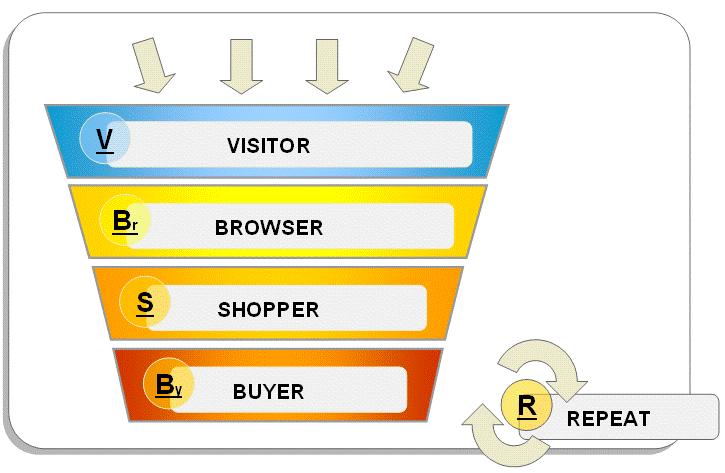
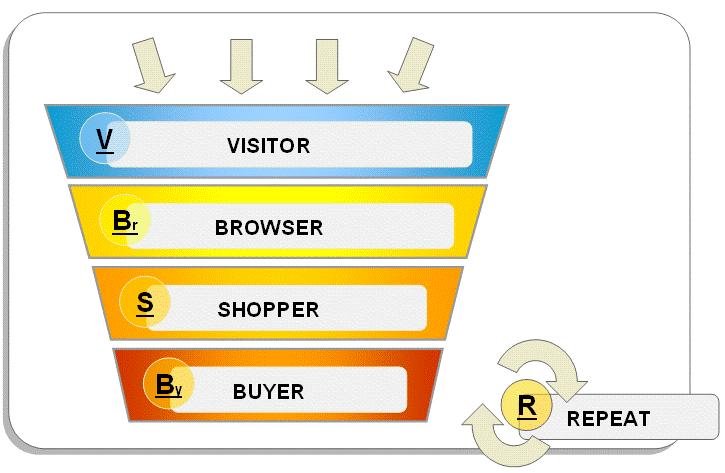
I think this is an interesting concept, but it is valuable as an additional view of visit or visitor conversion behavior, instead of as replacement to a funnel view. The funnel concept is still valuable in that it recognizes that there is a flow to the decision making process that consumers go through, and that your site needs to push people through that flow, whether it's literally a linear flow or not. If you think of the funnel as visitor based, not visit based, and you think of the funnel steps not as pages on the site, but qualification levels of the visitor (or how close they are to making a decision), you see that it is an extremely valuable visualization.

For example, your qualification levels might be:

  • Visitor (just the state of being a visitor - this isn't tied to a specific page of the site)
  • Browser (visitors who get to the category level or product level of the site -- or visitors who exhibit some other behavior indicative of a higher degree of engagement)
  • Shopper (visitors who add something to the cart, or who begin an application process)
  • Buyer (visitors who finally make a purchase, or who complete an application)
  • Repeat Buyer (buyers who buy again)


Although this looks linear, it isn't entirely linear in nature, as some consumers may enter the "qualification" funnel much more qualified (further down in the funnel) than others. There is no need to assume that a visitor must progress through each level, starting with the top. A visitor may become both a visitor and browser with just one page view, depending on where they land in the site.

And this is where the hub-and-spoke model that Shane proposes would seem to provide additional insight -- where do visitors enter the site, and how do they interact with the tools, features, and content that exist ultimately to drive purchase conversion (this is where revenue comes from, after all).

At the end of the day, each visualization is answering different questions and enabling a different kind of decision making. The visitor funnel answers macro-level questions about the level of engagement of prospects, and efficiency of the site at pushing prospects toward making a purchase decision. The hub-and-spoke answers micro-level questions about exactly how prospects arrive at the hub-level and move away from it. Together, the two views give marketing and site strategists the data needed to understand both raw visitor behavior, and the impact of visitor behavior on the conversion (and, by extension, revenue) performance of the site.

One note for banks and other financial services companies: Buyers in the example funnel above should be analogous to the revenue generating event you want your prospects to accomplish, or the closest thing to it on your site. For banks with online application processes that do not provide an approval decision online, "Appliers" is a good final step. For those that do provide an approval online, "Closers" would be a more appropriate final step of the funnel, and it should represent not only those that are approved, but those who actually accept the product and close the deal. Appliers, then, would be a good second-to-last step in the funnel, and this would give you insight into not only the efficiency with which your site encourages people to apply, but the quality of those people who do apply. It won't do you any good drive more people to apply if they're not credit-worthy.

I'm back...

I've been pretty head's down at work for the last 6 months, and haven't had time to write. Things are a bit more sane now, and I'm hoping to take some time at least once per week to write here. I'll still be focused primarily on financial services, but may occasionally stray to a broader set of topics within analytics.

Don't hesitate to send me your questions or comments.

-Aaron

Monday, November 28, 2005

Banking as Retail

Recently, while working the audience at an online retail event where the company I work for was presenting, I came across an individual who was actually in the financial services space. After brief introductions, he spent the next 5 minutes telling me about how he had virtually no professional resources available to help him do his job better the way online retailers do. So, he decided to come to an online retail event and see what he could glean.

I was ecstatic that he was there because, in fact, the sales side of Financial Services IS retail! Retail banks and consumer products retailers face many of the same challenges online, and retail banks can learn much from looking at the successes (and failures!) of their compatriots in the products space. To be successful, retail banks will have to start thinking of themselves, at least partly, as retailers. And from my experience, most retail banks are along ways away from this.

One of the best ways to start learning from products retailers is to look at the web analytics reporting that successful retailers have armed themselves with. Many of these powerful reports are applicable directly to retail banks and other financial services outfits. Some that immediately come to mind are:

  • Products reporting with revenue (yes, you can do this even if you don't transact money online!)
  • Products attributed to campaigns (which campaigns yield the most applications? the most revenue? the most valuable traffic?)
  • Cross sell reporting (how effective are you at getting applicants to add products to the "sale"?)
  • Product affinity reporting (what products are likely to be purchased by the same customer?)
  • Segmented conversion reporting (what types of visitors to your site are most likely to apply for specific types of products? to apply for multiple products over time?)
  • Campaigns reporting (onsite and offsite; which are successful, which should be scrapped)

The above list focuses on the public side of retail bank websites - the truly retail side. Of course, there is also the authenticated side, which is part self-service and part retail. In many cases, it makes sense to incorporate transactions and product sales from the authenticated side into the products reporting described above.

Also, you may have noticed that I left out "scenario analysis" reports from the list above. It's not that I don't think they're important -- they are crucial -- but I've left them out because scenario analysis reports are best used as part of a program of application conversion improvement (i.e. figuring out why applicants drop out of the process and fixing the problems causing them to drop out). They're not well suited to provide overall products reporting, though many banks continue to focus their reporting efforts on scenario analysis. In doing so, they're missing the huge opportunities that become apparent when the right reports provide the right insight.

Over the next few posts, I'll be focusing on how each of the above types of reports can help retail banks be successful online. I'd like to hear about your experiences with web analytics, too, from either a retail or financial services perspective.

Wednesday, October 19, 2005

Defining KPI's - Update

I thought a little bit more about how I described the process for defining KPIs - and I came to this realization...

While it is true that you have to know what your business objectives are in order to tie your web measurements into group-, division-, or company-wide goals, often times it's easier to start at number 3, Describe desired visitor behaviors, and work your way up (toward connection to management objectives), and down (toward KPIs and contextual data) from there. The end result is still the same - the ability to illustrate to management how what's happening on the web site is directly connected to the larger goals that management cares about.

Here's what that looks like applied to the top down approach described by Schiff in his post on KPIs.

Friday, October 14, 2005

Optimization Tip - The order of states in an address form

Checkout Jared Spool's post on this topic in his Brain Sparks blog. This is the type of minute detail that you have to focus on when you're optimizing business performance on your web site. This is especially relevant to retail (billing and shipping addresses) and retail banking and financial services (account applications).

If you want to achieve the greatest possible return from your investment in doing business online, leave no stone unturned when it comes to performance optimization. Seemingly small changes can add up to millions of incremental dollars annually. I know. I've seen it happen.

Tuesday, October 11, 2005

Measuring the Right Things [part 2] - Defining your KPIs

I've been thinking about this post for a few days now, trying to figure out just the right way to approach it. What's got me thinking about it is that I'm getting ready to engage with a new client to help them define a Key Performance Indicator framework they can use to enforce a more disciplined approach to site management within the organization. Additionally, they want a framework with which they can document the business value of the site to executive management.

Conceptually, defining KPIs is extremely simple...

1) Understand your Root Goal or Overarching Business Objective
2) Document the efforts you'll undertake or approaches you'll use to try to achieve those goals
3) Document the desired visitor behavior to result from your efforts
4) Express the ratio or data-point that lends insight into the scrutinized visitor behavior (this is a KPI)
5) State the individual measures that create the ratio or provided needed context to understand the KPI

What end up on your scorecard or dashboard is nos. 4 and 5. Numbers 1 through 3 you use to provide the overall business context when you write up your analysis of overall website performance for management.

Where most client-side analysts or site managers tend to fall down when deciding what to measure is failing to explicitly state and understand the Root Goal that 'efforts' and 'behaviors' are derivative of. Most of the time when I ask a client what their goals are they tell me about desired behaviors or eff0rts to affect behaviors, but they don't talk about the high-order objectives -- the Root Goal. As is true with any business, you need to understand your goals before you can understand your performance, or even what you need to measure to understand performance.

Here's an example of a fully defined KPI for a retail banking site:

1) Root Goal: Grow new account revenue 20%
2) Effort (or Approach or Method): Improve attach rate (cross sell performance)
3) Desired Visitor Behavior: Complete application with accessory products
4) KPI: % applications with accessory products
5) Contextual Data: # of applications, # of applications with accessories, AVG Revenue/Application (without attached accessory), AVG Revenue/Application (with attached accessory)

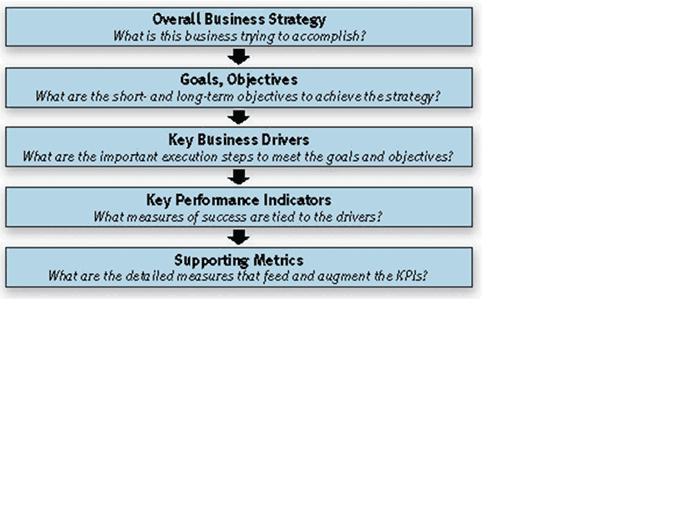
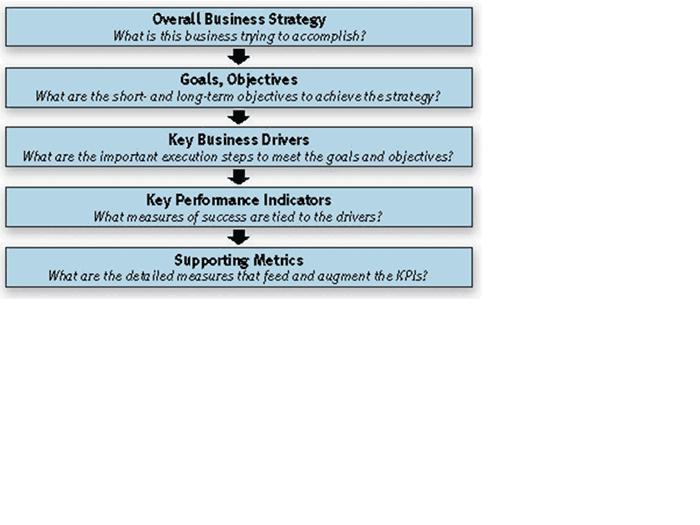
A colleague forwarded me this post from Craig Schiff while I was working on this post. In it, Craig does two things nicely (aside from being a smart guy): he provides a nice graphic illustrating the top-down definition of KPIs; and he clearly demonstrated to me how web analytics is just a little slice of BPM (Business Performance Management). We're working on exactly the same challenges, just on a different scale. The wording in his process is slightly different from mine, but they both get you to the same place.

Here's Craig's illustration:


One other note about Schiff's process -- I liked step 5 so much I included it in mine. I had not explicitly called out the needed contextual data separately. Instead, I was just including the contextual data as part of Step 4. It's much clearer when you call those out separately.

Thursday, July 07, 2005

Blog ROI

Heidi Cohen on measuring blog ROI

Haven't had a lot of requests from clients to measure the impact of blogs, but it sure seems like a good idea. You can easily build a hard-dollar case for the value of a blog by treating it as another piece of online media. Include your blog (or blogs) in your campaign reports and correlate conversion metrics, such as product views, purchases and revenue to customer behavior on your blog.

Don't sell stuff? Correlate any conversion, like lead capture, and assign a dollar value to each conversion event. You don't need to sell online to understand the revenue impact of conversion and the media driving conversion.

Wednesday, July 06, 2005

Measuring the right things. [part 1]

The thing I get asked to do the most, and the thing the most people seem to have trouble with, is identifying the right things to measure. It's not surprising that clients have so much trouble - the possibilities are crazy. You can measure anything (well, anything that's measurable).

It's actually an age old marketing problem - if you provide too many choices, the customer gets option paralysis. They can't make up their mind. In the classic marketing sense, option paralysis leads to a slowed or lost sale (I can't pick which one I want - it's too difficult). In the case of web analytics, it leads to data bloat (I want everything, just in case I might need it). Problem is, there tends to be an inverse relationship between the amount of data available and value derived. While it's true that we consumers want choices, we don't function very well if we have too many of them.

So in these cases, it's my job to help clients identify the right data - the key data points they should surface to understand, at a strategic level, the business performance of their web site. You may have heard of these data points...they're your Key Performance Indicators (KPI's). Of course, you need more than KPI's to manage a site. But the right KPI's will make using the rest of your data easy. They're like a road map in an unfamiliar city. Without them, you're completely lost.

Actually, come to think of it, they're more like the Neverlost GPS you get in your Hertz car. Well thought out KPI's actually tell you where to go.

Now, in my mind, KPI has become over used and under utilized. Lots of people talk about tracking KPI's, but very few people are tracking what I would call truly key performance indicators. Further, we run the same risks with KPIs as we do with data in general. Too many, or poorly organized, KPI's become just more data.

Stay tuned. In another post I'll talk about how I help my clients arrive at the right KPI's for their business.

What are we?

What are we... Web Analysts? Customer Behavior Analysts? Site Optimizers? Design Analysts? Web Analytics Gurus? [fill in the blank] Experts? Online Business Analysts? If you take into account where we come from, how we got to be Web Analysts (or whatever), you could add Usability Engineers, Interaction Designers, Information Architects, User Experience Analysts & Designers, Interface Designers, and Direct Marketers to the list. We're quite a varied bunch.

I'm not sure what the best title for us is, and I'm not sure we know enough about what we do and where we're going to have the right title just yet. I suspect there may be some specialization in the field required before the titles start to settle in. I'd be interested to hear your thoughts on how the field will specialize (or is specializing already).

Whatever you call us or what we do, it appears that, according to Jason Burby, we have very satisfying jobs. I would have to concur.